I am very pleased to say the Special Issue I edited for Digital Journalism has been published:
Allan, S. (2025) ‘Visual war journalism,’ Introduction to Special Issue. Digital Journalism. Available here.
Abstract: This Introduction to the Special Issue (SI) begins by discussing several risks, threats and dangers visual war journalists may be compelled to confront when performing the vital role of bearing witness, including ten specific imperatives of mediation. It proceeds to elaborate the conception of “visual war journalism” guiding the SI’s rationale and priorities, in general, before turning to examining in closer detail varied aspects of how ongoing conflicts in Syria, Ukraine and Gaza are being documented in visual terms, often under harrowing circumstances. Next, this Introduction offers a brief overview of each of its eight articles. It is the SI’s aim to foster dialogue and debate about visual war journalism’s trajectories today so as to encourage alternative, critical thinking about future prospects.
My sincere gratitude to the Special Issue’s contributors, the referees involved in the peer-review process, as well as the journal’s editor, Oscar Westlund, and its production team.
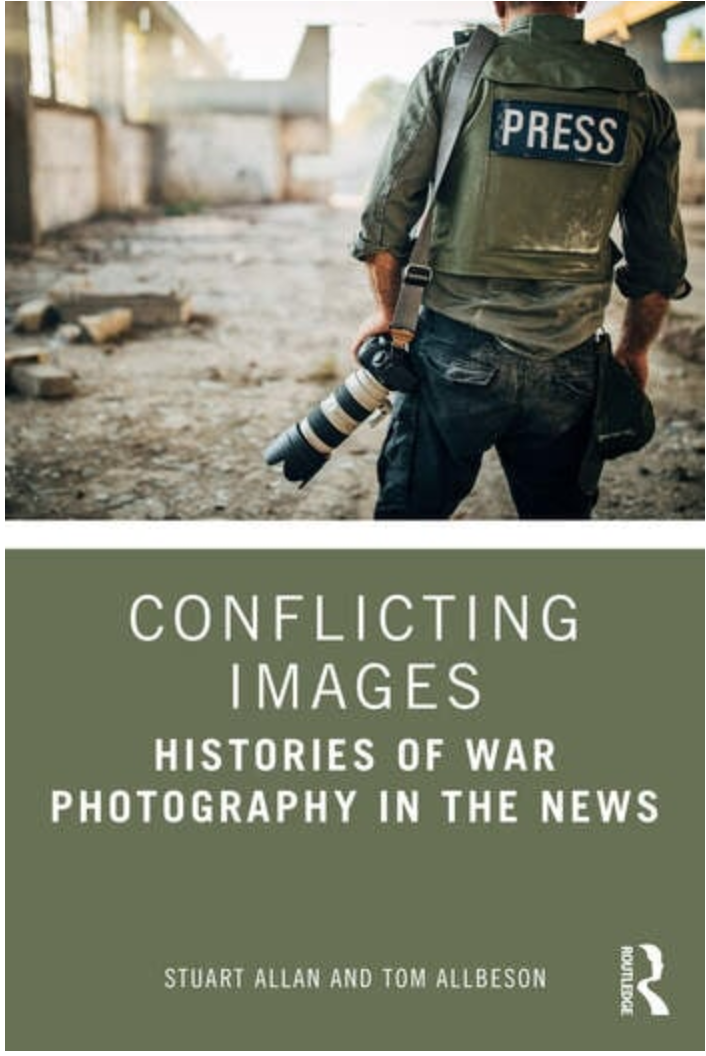
Very pleased to announce that Conflicting Images: Histories of War Photography in the News, co-authored with Tom Allbeson, has been published by Routledge.
Here is the abstract:
In contrast with historical examinations centring the evolving role of the war correspondent, Conflicting Images focuses on the contribution of photographers and photojournalists, providing an evaluative appraisal of war photography in the news and its development from the nineteenth century to the twenty-first century.
Stuart Allan and Tom Allbeson critically explore diverse genres of war photography across a broad historical sweep, encompassing events from the Crimean War (1853–56) and the Civil War in the United States (1861–65) up to and including conflicts unfolding in Syria and Ukraine. This book reflects on the relevance of different types of warfare to visual reporting, from colonial conquest via trench warfare and aerial bombardment, to the ideological dimensions of the Cold War, and ‘embedding’ and ‘winning hearts and minds’ during the ‘War on Terror’ and its aftermath. In pinpointing illustrative examples, the authors examine changing dynamics of production, dissemination, and public engagement. Readers will come to understand how current efforts to rethink the future of war photography in a digital age can benefit from a close and careful consideration of war photography’s origins, early development, and gradual, uneven transformation over the years. Conflicting Images aims to invigorate ongoing enquires and inspire new, alternative trajectories for future research and practice.
This book is recommended reading for researchers and advanced students of visual journalism and conflict reporting.
Just in case you would like a free PDF of an article Tom Chivers and I co-wrote, “A public value typology for public service broadcasting in the UK,” published in Cultural Trends (Volume 33 Issue 2), it is now available here:
Rapid changes in audience habits, media technologies and marketdynamics have prompted searching questions about the role andrelevance of public service broadcasting (PSB) in the moderndigital media landscape. In the UK, where cultural policymaking isincreasingly politicised, the normative ideals traditionallyassociated with PSB are being openly contested. This articleevaluates how PSB generates varied forms of“public value”ofbenefit to viewing and listening publics, policy stakeholders andthe creative sector. On the basis of its qualitative analysis ofpolicy documents and related research literatures over twodecades, a typology of six values–social, cultural, economic,industrial, representational and civic–is identified and critiquedacross regulatory and institutional frameworks. In assessing thechallenges, risks and opportunities for sustaining these publicvalues, this article offers its typology for informing cultural andmedia policy debates on the future of PSB in the UK and beyond.
Eva Nieto McAvoy and I are pleased to share an open access article, ‘Mediations of cultural policymaking during COVID-19: British newspaper reporting of the Culture Recovery Fund,’ published in the International Journal of Cultural Policy.
Abstract
At the height of the COVID-19 pandemic, cultural policymaking frequently came to the fore in media debates about the impact of the crisis and measures to alleviate it. In this article, we present evidence of how newspaper coverage of the cultural and creative industries (CCIs) identified and framed competing perceptions of the relative utility of policymaking in this context, while also problematising familiar assumptions about the CCIs among policymakers, journalists and (arguably) the public. Specifically, we analysed British news and editorial items (n.4,162) published from 1 January 2020 to 31 December 2020. It offers a novel investigation into the ways in which media and policy rhetoric overlap, interact and influence each other. In doing so, this article contributes a unique perspective to the study and practice of cultural policy, bringing to light the typically underexplored role of the news media in shaping the narratives driving cultural policy deliberation and action.
I am very pleased to announce the second edition of The Routledge Companion to News and Journalism has been published.
Book description:
The Routledge Companion to News and Journalism brings together scholars committed to the conceptual and methodological development of news and journalism studies from around the world.
Across 50 chapters, organized thematically over seven sections, contributions examine a range of pressing challenges for news reporting – including digital convergence, mobile platforms, web analytics and datafication, social media polarization, and the use of drones. Journalism’s mediation of social issues is also explored, such as those pertaining to human rights, civic engagement, gender inequalities, the environmental crisis, and the Black Lives Matter movement. Each section raises important questions for academic research, generating fresh insights into journalistic forms, practices, and epistemologies. The Companion furthers our understanding of why we have ended up with the kind of news reporting we have today – its remarkable strengths, the difficulties it faces, and how we might improve upon it for tomorrow.
Completely revised and updated for its second edition, this volume is ideal for advanced undergraduates, postgraduates, researchers, and academics in the fields of news, media, and journalism studies.
Table of Contents
Introduction: The value(s) of truth-seeking in news and journalism
Stuart Allan
PART I Journalism and Democracy
News and the Public Sphere
C.W. Anderson
India’s Imperilled Public Sphere: Challenges to Independent Journalism in the World’s Largest Democracy
Kalyani Chadha
The Political Economy of Contemporary Journalism and the Crisis of Public Knowledge
Peter Golding and Graham Murdock
Journalism and Community Engagement as if Democracy Matters
Lana F. Rakow
The so-called “crisis” of trust in journalism
Rachel E. Moran
Journalists, Epistemology, and Authority
Matt Carlson
Social Roles of Journalism
Tim Vos
Bargaining with local journalism’s value
Kristy Hess and Lisa Waller
PART II Rewriting the Rules of Reporting
Journalism’s Multiple Gods: Objectivity, Its Variants, and Its Rivals
Michael Schudson
Newsroom cultures at risk? Journalism’s reliance on web metrics and analytics
Valérie Bélair-Gagnon and Avery E. Holton
The Changing Status of Women Journalists
Linda Steiner and Dinfin Mulupi
Digital Journalism in China: Media Convergence, the ‘Central Kitchen’ and the Platformization of News
Jing Meng and Shixin Ivy Zhang
Convergent Journalism: Cross-media content strategies to improve the quality of Thai news reporting
Sakulsri Srisaracam
Pop Up Newsrooms: From New Collaborations to Counter Narratives
Melissa Wall
Online trolling of journalists
Silvio Waisbord
PART III News, Mobilities and Data
Witnessing George Floyd: Tracing Black mobile journalism’s rise, impact and enduring questions
Allissa V. Richardson
Mobility, smartphones and news
Andrew Duffy and Oscar Westlund
Journalism and Data Justice: Critically Reporting Datafication
Arne Hintz, Emiliano Treré and Naomi Owen
Balancing between “statistical panic” and “statistical boredom”: News, numbers and narratives in the risk society
Brendan Lawson and An Nguyen
Hybrid journalism
Stephen D. Reese
Podcast journalism and performative transparency
Mia Lindgren
Drone journalism: the invisibility of the aerial view
Jonas Harvard
PART IV Crisis, Conflict and War Reporting
News reporting of the COVID-19 Pandemic: Perspectives from the Global South
Sara Chinnasamy and Felipe F. Salvosa II
Risk journalism and globalized crisis ecologies: Journalists as ‘cosmopolitan’ actors
Ingrid Volkmer
Video Journalism and Human Rights
Sandra Ristovska
Beyond verification: UGC as embodied testimony in conflict news
Lilie Chouliaraki and Omar Al-Ghazzi
The Ethics of War Reporting
Donald Matheson
News Reporting of Pakistan and the War on Terror
Shahzad Ali and Ahmer Safwan
Photojournalism and the US-led invasion of Afghanistan
Stuart Allan
PART V Representing Realities
Journalism and Environmental Futures
Libby Lester
News reporting of poverty and inequality
Jairo Lugo-Ocando
Journalism and Gender Violence
Lisa Cuklanz
Women in Sports News: Challenges posed by the emergence of popular feminism
Erin Whiteside
Celebrity News Online: Changing Media, Actors, and Stories
Anne Jerslev and Mette Mortensen
Girls, News, and Public Cultures
Cynthia Carter and Kaitlynn Mendes
Socially Responsible Journalism: Diverse Responses to Polarisation
Laura Ahva
PART VI Envisioning Alternative Journalisms
News Audiences and the Challenges of Digital Citizenship
Chris Peters
Contextualizing Citizen Visual Journalism: Narrative and Testimony
Mary Angela Bock
Citizen Journalism, electoral conflict and peace-building processes in Kenya and Zimbabwe
Jacinta Maweu and Admire Mare
Journalism and counterpublics: Is journalism for all the people?
Bolette B. Blaagaard
News Literacy Practice in a Culture of Infodemic
Paul Mihailidis
Journalism and Ethnoracial Minorities
Sherry S. Yu and George L. Daniels
Teaching innovation and entrepreneurship. Journalism students as change agents?
Marcel Broersma and Jane B. Singer
PART VII Globalising Journalisms
Comparing journalistic cultures across nations
Folker Hanusch
Fringe Benefits: Weekly Magazines and Access Journalism in Japan
David McNeill and Kaori Hayashi
Arab Investigative Journalism: Exploring Processes of Cultural Change
Saba Bebawi
Theorizing Journalism and the Global South
Bruce Mutsvairo and Kristin Skare Orgeret
Mapping anti-press violence in Latin America: Prospects for reform
Mireya Márquez-Ramírez
Devalued News Workers in the Labor of International Journalism: Local Stringers and Fixers
Abstract: Rapid changes in audience habits, media technologies and market dynamics have prompted searching questions about the role and relevance of public service broadcasting (PSB) in the modern digital media landscape. In the UK, where cultural policymaking is increasingly politicised, the normative ideals traditionally associated with PSB are being openly contested. This article evaluates how PSB generates varied forms of “public value” of benefit to viewing and listening publics, policy stakeholders and the creative sector. On the basis of its qualitative analysis of policy documents and related research literatures over two decades, a typology of six values – social, cultural, economic, industrial, representational and civic – is identified and critiqued across regulatory and institutional frameworks. In assessing the challenges, risks and opportunities for sustaining these public values, this article offers its typology for informing cultural and media policy debates on the future of PSB in the UK and beyond.
Just over a year ago, Tom Chivers and I co-wrote a submission of written evidence in response to the ‘Consultation on a change of ownership of Channel 4 Television Corporation,’ Department for Digital, Culture, Media and Sport (14 September, 2021). This DCMS consultation called for views and evidence on the potential change of ownership of Channel 4 Television Corporation.
Our submission is now in the public domain via the Creative Industries Policy and Evidence Centre (Nesta, London). Any and all comments welcome!
This Discussion Paper presents the findings of a study examining British newspaper coverage of the COVID-19 pandemic’s impact on the cultural and creative industries (CCIs) from 1 January to 31 December 2020 (n.4,162). It assesses the broad contours of this coverage before focusing on a pivotal week – 3 to 10 July – where we find the highest concentration of items reporting on the Culture Recovery Fund (CRF) and on freelancers in the arts and cultural sector (n.215). We explore the following questions: (1) how are issues central to the Culture Recovery Fund and freelancers framed / represented in the coverage? (2) How is the government response to the crisis in the cultural and creative industries characterised and responsibility attributed?; (3) what actors (sectors, institutions, locations) are present in the coverage, which ones are the key sources, and how are their views represented? We found that the framing of the issues in news items mostly offered narrow parameters of discussion, proving overly reliant upon official press releases, and affording space to a limited range of voices.
Available for free here. All comments and suggestions welcome!
Chivers, T. and Allan, S. (2022) ‘Privatising Channel 4: The evidence behind the debate,’ 12 April, Creative Industries Policy & Evidence Centre. London: Nesta.
Allan, S. and Chivers, T. (2022) ‘Envisioning Broadcasting Anew: Responding to the White Paper on the future of UK broadcasting policy,’ 11 May, Creative Industries Policy & Evidence Centre. London: Nesta.
Please follow Tom and me on Twitter for further posts.

 Stuart Allan